It’s 11:54 PM on Friday, March 27, 2023, and this is the first long-form piece I’ve decided to write for my blog malvag.io. It’s not a quick read like the things I post on LinkedIn, and I don’t think it’s an easy one either. Grab some chips and a fizzy drink — let’s go.
The Trajectory of Modern Computing
The more I watch the direction the digital world is taking — a world I helped build — the more I’m convinced that we’re heading into a transition that will be very hard to avoid. One that, in my view, will mark the end of personal computing as we know it: the idea that you own your hardware and run software on your own machine. In its place, we’re getting an unwelcome throwback to the mainframe era we escaped in the early 1980s. The force accelerating this transition is artificial intelligence.
We already had a preview of this new era in the late 2010s and early 2020s, when we started trading software that ran entirely on our own PCs — software we actually owned — for “as a service” alternatives running in cloud datacentres.
- CRM? Salesforce.
- Music? Streaming.
- A document editor? Only if you pay a subscription to Google or Microsoft.
- And so on.
Then AI arrived, and the metamorphosis accelerated — not because of any single technological breakthrough, but through the convergence of aggressive economic dynamics, a structural shortage of semiconductors, and a geopolitical situation that is making the world increasingly fragmented and decreasingly globalised. What’s happening in the United States, and its ripple effects in Ukraine and Iran, are symptoms of this. But the signals are everywhere, if you bother to look.
The point is that with AI, computing power — not just software — is migrating back to the datacentre and away from your PC. Looking at what’s happening in the RAM and hard drive markets, it’s easy to sketch a scenario where the physical device becomes a mere access terminal — operationally inert — while computational power and data control shift irreversibly toward proprietary cloud infrastructure.
The Economics of Obsolescence: The Hardware-as-a-Service Model
Nobody seemed particularly surprised when legacy consumer hardware vendors — Western Digital for hard drives and Micron for RAM — recently announced they were exiting the consumer market entirely in favour of enterprise and datacentre customers.
The shrinking availability of hard drives, SSDs, and RAM chips is already pushing up prices for personal hardware, driven by supply chain contraction and the oligopolistic practices that inevitably follow.
On top of that, the shift from capital expenditure (CapEx) to operational expenditure (OpEx) models has transformed how organisations — and increasingly, individual users — relate to hardware. The Hardware-as-a-Service (HaaS) model is emerging not as a niche option but as the dominant strategy for manufacturers looking to stabilise revenues through recurring subscriptions, exactly as happened with SaaS in the software world.
Under HaaS, the end user stops owning hardware and becomes a perpetual tenant. The vendor manages the entire device lifecycle — from installation to maintenance to disposal. This is marketed as a way to reduce upfront costs and guarantee access to up-to-date technology, but the reality is a substantial loss of control over how long your device lasts and what you can actually do with it.
A lock-in effect emerges through the bundling of hardware, proprietary software, and maintenance services — multiplying vendor profits while shrinking user freedom.
The tight integration between proprietary software and specific hardware also makes independent intervention nearly impossible. You may know the John Deere tractor story: expensive machines locked down by software so restrictive that farmers couldn’t repair them independently, forcing them into costly maintenance contracts. Now imagine that dynamic moving into your home.
Do we really need to be locked out of our own devices and stripped of the skills to maintain them? The photos we take, the relationships we build, the music we listen to, our memories — all of it in someone else’s hands.
The Trojan Horse of Artificial Intelligence
The rise of artificial intelligence is becoming the most powerful catalyst for dismantling personal computing as we’ve known it for the past 40 years. The so-called “scaling laws” of AI mean that the power required to train and run advanced models increasingly exceeds what local devices can deliver.
Prominent figures in the industry — Jeff Bezos among them — have described the traditional PC as a “museum piece”, suggesting that the heavy lifting will migrate to large server farms.
This marks a cyclical return to the era of “dumb terminals” from the 1960s and 70s, where the power lived in the mainframe and the user had nothing but a keyboard and a screen. In this new version, the laptop becomes a streaming receiver.
The promise is to make an old computer perform like a modern workstation — but the price is total dependence on connectivity and the surrender of control over your data.
Microsoft’s strategy, with Windows 365 and Copilot, is heading squarely in this direction: the operating system becomes a service, and the local machine becomes an access point.
The Diversification of Intelligence and the Risk of Homogenisation
While a “Personal AI” (PAI) movement exists — trying to keep intelligence on local devices to improve privacy and personalisation — market forces are pushing in the opposite direction: centralisation. The risk of this model is the homogenisation of thought and the instantaneous propagation of errors or biases across the entire digital ecosystem. If a single cloud model makes a systematic error, that error doesn’t stay contained — it reflects across every connected user, creating a fragility that simply didn’t exist in a world of distributed, independent computing.
Structural Scarcity and the “RAMmageddon” of 2026
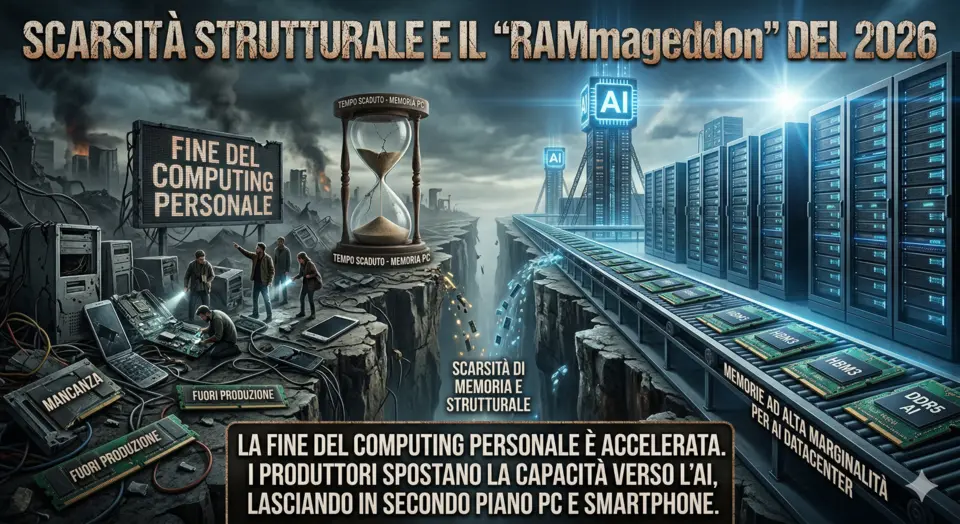
The decline of personal computing is also being accelerated by a very concrete problem: the physical availability of components. Between 2025 and 2027, the global market entered a phase of unprecedented memory scarcity, dubbed by the press “RAMmageddon” or “RAMpocalypse”. Unlike the chip shortage of 2020–2023, which was largely driven by pandemic-related logistics failures, this crisis is structural: manufacturers are redirecting production capacity toward high-margin memory destined for AI datacentres, leaving PC and smartphone components as an afterthought.
This dynamic is building an economic barrier that’s increasingly hard to clear for anyone who wants to own powerful local hardware. According to Gartner and IDC, entry-level laptops under $500 will become economically unviable by 2027 — in part because memory can now account for up to 35% of a PC’s total cost, compared to 15–18% just a few years ago. Manufacturers like Dell and Lenovo have already started passing these increases on to end customers, with price hikes of up to 15%. In some cases, systems are being sold without RAM, leaving users with the often-unsolvable problem of sourcing modules in a market dominated by scalpers and the purchasing priorities of major cloud players.
The AI PC Paradox
Meanwhile, the industry is pushing hard on “AI PCs” — machines with integrated NPUs that require significant amounts of RAM (at least 16GB, ideally 32GB or more) to deliver on their promises. The problem is that the same AI demand driving these devices is also the cause of the memory scarcity making them increasingly unaffordable. The result is a paradox: machines designed for AI that, in practice, risk being underpowered — forcing users back to the cloud to compensate for their hardware limitations.
Security or Control?
Modern hardware architecture is integrating security mechanisms that, while genuinely effective against traditional malware, are steadily shifting control away from the user and toward the vendor. Technologies like TPM 2.0, Secure Boot, and Microsoft’s Pluton security processor create an environment where hardware can attest its software state to third parties.
TPM 2.0 and Remote Attestation
TPM 2.0 became a requirement for Windows 11 and functions as a cryptographic vault for keys and certificates. The most sensitive part is “Measured Boot”: every phase of the startup process is recorded, and if something doesn’t match — a modified kernel, an unsigned bootloader — the TPM can refuse to release the keys needed to access your data. Through remote attestation, external services (streaming platforms, anti-cheat systems, various platforms) can verify these measurements and decide whether to grant access.
Microsoft Pluton pushes this model further. By integrating the security processor directly into the CPU, it eliminates certain classes of hardware attacks — but also introduces direct control over firmware managed through Windows Update. Pluton uses a Rust-based operating system (Tock OS) for memory safety, but that’s not the main point: the key feature is the ability to continuously update firmware and security policies without going through the user or the PC manufacturer. In practice, this creates a chip-to-cloud continuum in which control over your hardware is no longer really yours.

The “Bricking” Policy: Firmware as a Tool of Coercion
Once control shifts to the firmware layer, remotely disabling devices becomes possible. “Bricking” — turning a device into an expensive paperweight — is no longer an accident. It’s a feature.
A concrete example: HP’s “Dynamic Security” — firmware updates that lock printers if they detect unofficial cartridges. In March 2025, a faulty update bricked numerous LaserJet printers even with genuine cartridges installed, displaying a generic “Error 11” and rendering the machines useless. HP justified the decision by citing potential “viruses” in third-party cartridges — a claim met with considerable scepticism from security experts.
Legislative Resistance and the Right to Repair
In response to these dynamics, the European Union introduced the Right to Repair Directive, which entered into force in July 2024 and is set to become fully operational by 31 July 2026. The goal is to counter planned obsolescence and extend the lifespan of devices.
Key measures include:
- availability of spare parts for 5–10 years
- access to manuals and diagnostic tools
- prohibition of software locks that prevent repair
- a repairability index visible at the point of purchase
The problem is that these rules collide directly with architectures like Pluton. If a lockdown is justified as a security necessity, there’s room to work around the regulation. And there’s another issue: most hardware vendors are American or Chinese, while European manufacturing is marginal. That makes real enforcement far from guaranteed. The risk is the usual race to the bottom — rules that exist on paper but get bent in practice.
AI on the Edge: The Frontier of Digital Sovereignty
As a reaction to this drift toward centralisation, a movement is emerging that aims to bring AI back to the local device: AI on the edge. The idea is straightforward: less cloud dependency, more control, more privacy.
I’ve tested free, open-source software like Ollama, which lets you run language models on ordinary PCs with modern GPUs — without sending your data to OpenAI or Google. I’ve also tried projects like OpenClaw, which allow you to install AI agents directly on local hardware.
It works, but with clear limitations: you need RAM and VRAM in quantity — precisely the components that are becoming increasingly scarce and expensive. You also need a reasonable familiarity with development environments and Unix-based systems. In the end, the simplest configurations are still the remote ones. And so you always end up back at the same place.
Final Thoughts: The Transition Toward a Technological Dualism
The future of computing will not be uniform. Two distinct models are taking shape.
On one side: a consumer world of cheap but closed devices, heavily cloud-dependent, managed through subscriptions, and locked down by security systems that prevent any unauthorised intervention. Here, the user is a consumer, not an owner.
On the other: a more autonomous model, built on expensive hardware, open-source software, and local AI — accessible to those with the skills and resources to afford it. This second group will have to contend with rising costs and constant pressure from closed ecosystems.
The end of personal computing won’t be a single event — it will be a slow erosion, sold each time as convenience, security, or savings. Maintaining control over your own digital tools will increasingly become an active choice, not the default state.
If there’s a strategy, it lies in reducing cloud dependency wherever possible, supporting the right to repair, and maintaining a critical eye toward technologies that, under the guise of security, quietly move control elsewhere. The end of personal computing is not inevitable — but avoiding it requires a conscious effort.